Batteries and butterflies: abundance and resilience
“Are we there yet?”
“Almost, Lukas, we will stop for a charge in about 10 minutes. Can you wait that long?”
“Ugh, I guess. I really want to move my legs! They need to run!” The passenger seat creaks next to me as he stretches his legs.
“I hear you, bud, we’ll have some time to stretch out as the car charges. Then, to Grandma’s house we go!”
I pull into the bay and plug in the car. My phone says it’ll take 20 minutes to a full charge. I stretch and look up. Gold has begun to tinge the sky. The sun will set soon, and the grid will shift from solar power to battery, hydro, geothermal, and wind, power traveling from as far away as Maine. Volts zipping down the wires that line the roads and cross the streets like mycelium shifting nutrients, or in this case, energy from where it’s abundant to where it’s needed. Miraculous really. I’d like to get this final charge during the abundant solar hours. I walk over to Lukas’s door and open it.
“Okey dokey artichoke-y. You ready?” He grins, unbuckles his belt, and jumps out of the car.
I hold out my hand. He wraps his fingers around mine, and we walk to a beautiful wooded trail. It’s July and bursting at the seams with green leaves and fuchsia cone flowers.
“Wanna race, Aunt Allie?” He grins.
“Always.” I smile and let him get a few strides’ head start.
I jog to him as he runs in circles, chanting, “Keep up, slowpoke.”
It feels good to run. To wake my body and ask more of it than just the firing of neurons in my skull. As we make our way into the cool thicket, he slows. I can see his little shoulders relax, his inhale deepen, and his entire nervous system calm as we enter the trail. He still takes twice as many steps as I do, because he stops here and there to inspect a leaf or insect. He’s into nature. I like to think he gets that from me. Soon, he’s pulled up the university’s biodiversity tracking app to log species. He takes his citizen science research very seriously.
Long distance car travel wasn’t always this way. My first two cars relied on fossil fuel for power. I remember stopping at gas stations to refill my tank, and yes, it was quicker, but you never knew what kind of shape the gas station would be in. One near my parents’ house was so thick with cigarette smoke that my Mom always joked with my Dad, who was very much NOT a smoker, that he must’ve had his pack for the day when he’d come back from being inside. The stations lured people in with sweet or salty treats, lottery tickets, or “clean” bathrooms, though this was always a toss-up. But I can guarantee none of them had a park or a walking trail. In fact, it was almost as if they were trying to create some alternate universe that scrubbed away all biodiversity. Only the most stubborn – dandelions and, in the summer, wasps – stuck around. Gas stations were slabs of concrete and asphalt illuminated by a false sun of LED bulbs twenty four seven, three sixty five. Wastelands of oil stains, plastic bottle caps, and cigarette butts. I wonder what archeologists in the future will make of it. The Anthropocene for sure.
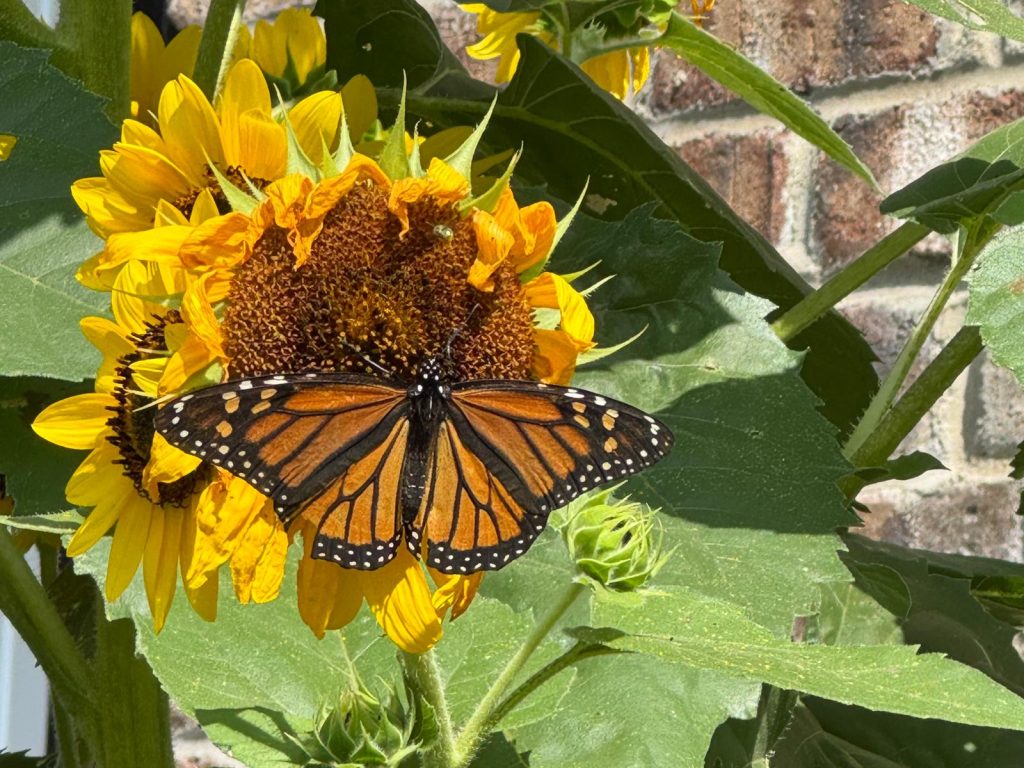
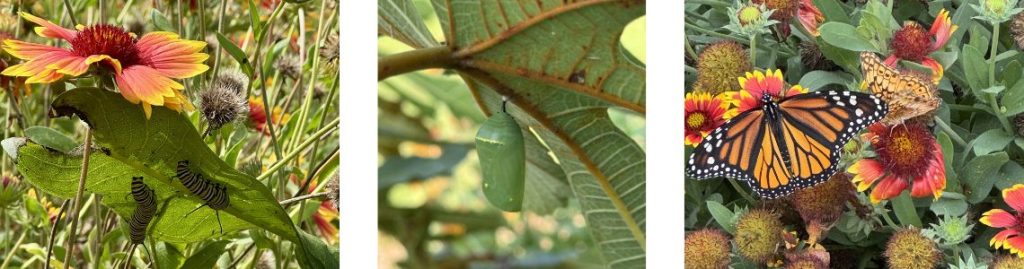
“Allie!!! A Monarch caterpillar!” Lukas screeches, jolting my attention towards him. He knows Monarchs have a special place in my heart, having planted mounds and mounds of milkweed, their host plant, in my backyard. Every summer when he visits, we do a daily inventory of the caterpillars and chrysalises. Excitedly observing them move through their stages.
“Look at that! What do you think? Is it, second or third instar?”
“Gotta be third, look at how chubby he is!” Luke says in awe.
I smile. “I think you, sir, are right! That is one grade-A chonky caterpillar.”
He gives me a conspiratorial grin and backs away gently. As the creature continues to munch on a leaf. I think about the journey south this Monarch will take using just the wind and energy from these little leaves, miniature ancient solar arrays. Plants, you know, had this solar power thing figured out long before us.
“Safe travels, little one,” I whisper in silent blessing.
I look up and see Luke is watching me. “Safe travels, little friend,” he whispers.
My heart bursts in moments like this. He is so good. Maybe too good for this world. But that’s why I do the work I do, to try and make the world worthy of him. Of this entire generation, one that has never known wars waged over oil. A generation that has stubbornly dug in its heels and said “No more. Not one more species lost, not one more point of a degree of global temperature increase. Enough.”
Though his generation is growing up with abundant clean energy, Luke is living in a world shaped profoundly by the impacts of humans’ reliance on fossil fuels. His beloved insects have seen a 20% decline since I was a kid. The air he breathes is still tainted with pollution from the last sputters of fossil energy, and the coasts I made sandcastles on aren’t safe anymore, as rising tides consume homes built along the shore. But I’m trying to be positive, and so I focus on this moment saturated in green and gold and abundance.
Bzzz – my phone sends a 5 minute notice. Jolting me back to reality. The car is nearly charged. Luke is a few steps ahead and crouched down alongside the path again.
“Time to turn it around, bud. Race you back?”
“Last one back is a rotten egg,” Luke says as he races past.
I smile and jog off after him.
It’s good to see some things haven’t changed.
 Allison Whitaker
USA
Allison builds climate awareness and engagement programming in her home state of North Carolina. She is cultivating resilience through her creative writing practice.
View all posts
Allison Whitaker
USA
Allison builds climate awareness and engagement programming in her home state of North Carolina. She is cultivating resilience through her creative writing practice.
View all posts